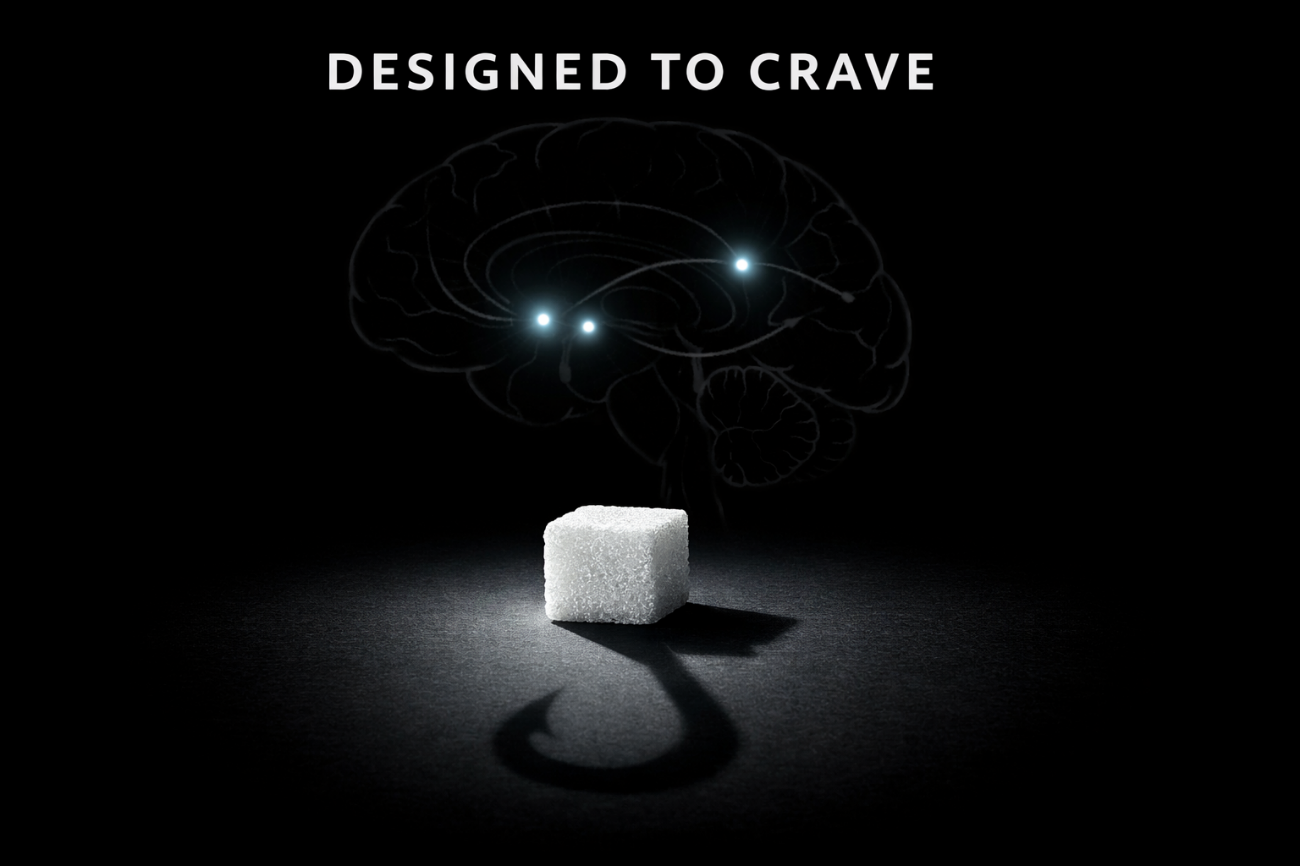
Introduction: Sugar Isn’t “Poison”—Exposure Is the Problem
Sugar isn’t “toxic” in the classic sense. The risk emerges from dose, frequency, and displacement—especially within an ultra-processed dietary pattern.
Ultra-processed foods (UPFs) are industrial formulations engineered for convenience and hyper-palatability. They commonly combine:
- Added sugars
- Refined starches
- Fats
- Low fiber
That combination weakens satiety signals and makes high-frequency exposure easy.
The public-health issue isn’t one dessert. It’s daily, repeated exposure—breakfast through bedtime—embedded in the UPF environment.
Key Takeaways
- Ultra-processed foods (using the NOVA food classification system framework) are multi-step industrial formulations with ingredients uncommon in home kitchens.
- In the U.S., estimates suggest over half of total calories (often cited ~57%) come from UPFs.
- Fructose (from sucrose and high-fructose corn syrup) has distinct metabolic handling in the liver.
- Fructose-sweetened intake in controlled settings has shown lower insulin and leptin responses and reduced ghrelin suppression compared with glucose—biologically consistent with weaker satiety signaling.
- Fructose is largely metabolized in the liver, contributing to de novo lipogenesis, higher triglycerides, and pathways linked to insulin resistance and fatty liver.
- World Health Organization guidance recommends keeping free sugars below 10% of total energy, with an ideal target of <5% for additional benefit.
Scope
This article addresses nutrition risk and chronic disease pathways, not acute contamination (e.g., pathogens or toxins).
Audience: Food safety/QA leaders, regulatory professionals, product developers, educators.
Disclaimer: Informational only; not medical or legal advice.
Hazard vs Risk (Applied to Sugar)
Sugar is not a hazard like Salmonella in the immediate sense. The risk comes from:
- Dose
- Frequency
- Displacement of protective foods
- Context (low fiber, refined structure)
Ordinary nutrients can become harmful over time at modern exposure levels—because ultra-processing makes overconsumption frictionless.
What Counts as Ultra-Processed? (NOVA, in Plain English)
Using the NOVA food classification system framing:
Minimally Processed
Washed vegetables, pasteurized milk, butchered meat—altered mainly for safety and storage.
Processed
Canned vegetables, cheese, fresh bread—recognizable foods with limited added salt, sugar, or fermentation.
Ultra-Processed (UPFs)
Industrial formulations with:
- Multiple processing steps
- Ingredients uncommon in home kitchens
- High added sugars, refined starches, fats, salt
- Low intact fiber and structure
Examples:
- Sodas and energy drinks
- Packaged snacks
- Sweet cereals and pastries
- Instant noodles
- Many ready-to-eat meals
UPFs aren’t risky because they’re processed. They’re risky because they’re engineered for repeat consumption and weak satiety.
The Mechanism: Why Fructose Is Different
1️⃣ Satiety Signaling
Controlled research has shown fructose-sweetened intake can produce:
- ~65% lower insulin response
- ~21% lower 24-hour leptin levels
- Less effective ghrelin suppression
That hormonal pattern aligns with “still hungry after calories.”
2️⃣ Liver-First Metabolism
Fructose is primarily metabolized in the liver. It can:
- Rapidly generate substrates for de novo lipogenesis (DNL)
- Increase triglycerides and VLDL production
- Contribute over time to insulin resistance and fatty liver pathways
This is why NAFLD fructose discussions often focus on chronic, high intake.
3️⃣ Uric Acid & Blood Pressure Pathways
Fructose metabolism consumes ATP and increases uric acid production, a pathway linked to hypertension and insulin resistance mechanisms.
4️⃣ “Alcohol Without the Buzz” (Careful Analogy)
There are mechanistic parallels between hepatic fructose metabolism and ethanol metabolism—particularly in liver fat and dyslipidemia pathways.
This is an explanatory analogy, not a claim that sugar is literally alcohol.
Sugar’s Trojan Horse: How Ultra-Processed Foods Scale Exposure
UPFs are engineered around sugar because sweetness:
- Improves repeat purchases
- Masks formulation imperfections
- Drives “bliss point” optimization
Unlike contaminants or many additives, there is no “premarket approval” for a total dietary pattern dominated by UPFs—and no universal legal cap on added sugars in many products.
That shifts the burden to consumer behavior inside a highly engineered environment.
Whole-Food Sugar vs UPF Sugar (Context Matters)
| Feature | Whole Food (e.g., fruit) | UPF Pattern |
| Fiber/structure | Intact fiber slows absorption | Low fiber + refined carbs |
| Delivery speed | Chewing + volume limit dose | Liquids/snacks deliver sugar fast |
| Displacement | Adds nutrients/phytonutrients | Often replaces protective foods |
The risk isn’t sweetness alone. It’s sweetness + speed + low satiety + high frequency.
What Guidance Actually Says
The World Health Organization recommends:
- Free sugars <10% of total energy
- Ideally <5% for additional benefit
For many adults, 5% translates to ~25 grams/day (about 6 teaspoons).
Professional translation:
If your product portfolio—or personal diet—regularly pushes above those levels via beverages and snack foods, you are operating in the risk-relevant zone.
Epidemiology: Sugar-Sweetened Beverages (SSBs)
Systematic reviews and meta-analyses consistently associate high intake of sugar-sweetened beverages with:
- Increased weight gain
- Higher risk of type 2 diabetes
- Greater cardiometabolic risk
Liquid sugar is particularly important because it delivers high doses with minimal satiety compensation.
Myth-Busting
Claim: “Sugar is just empty calories.”
What’s wrong:
“Empty” implies inert. Mechanisms like satiety hormones, liver fat synthesis, and uric acid pathways are not inert.
Correct interpretation:
High-frequency added sugar exposure—especially in UPFs—drives metabolic disruption over time.
Claim: “Processing is the problem.”
What’s wrong:
Cooking, pasteurization, fermentation are not harmful by default.
Correct interpretation:
The risk signal is ultra-processing patterns—hyper-palatability, refined structure, high added sugar, low fiber.
Claim: “If it’s in healthy packaging, it’s fine.”
What’s wrong:
Added sugars hide behind multiple names and appear in unexpected categories.
Correct interpretation:
Evaluate added sugar grams and fiber—not front-of-pack imagery.
What To Do
For Individuals (Highest ROI Moves)
- Cut liquid sugar first (soda, sweetened coffee, energy drinks).
- Rebuild breakfast around protein + fiber.
- Swap UPF snacks for whole-food snacks (nuts, fruit, yogurt with low added sugar).
- Use fiber as a heuristic: sweet + low fiber = high-risk delivery format.
For Food Companies (FSMS-Adjacent Actions)
- Portfolio mapping: Identify SKUs where sugar drives repeat purchase vs technical necessity.
- Reformulation: Reduce added sugar—especially in beverages and breakfast categories.
- Label clarity: Make added sugars easy to interpret.
- Equity lens: Healthier options must be financially reachable.
FAQ
What are ultra-processed foods?
UPFs are industrial formulations with multiple processing steps and ingredients uncommon in home kitchens.
Why are UPFs linked to overeating?
They are engineered to be hyper-palatable and less satiating, and they dominate calorie intake in some regions.
Is fructose worse than glucose?
Fructose has distinct liver-first metabolism and weaker satiety hormone responses in controlled settings. The most defensible framing is “different metabolic pathways.”
What does WHO recommend?
Free sugars below 10% of energy, ideally below 5%.
Companion Topics
For a broader systems lens, see related discussions on:
- Real risks in food
- What is food safety
- GMO
- Food fraud
- HACCP
Final Takeaway
Sugar becomes a meaningful public-health risk when ultra-processed foods:
- Increase frequency
- Reduce satiety
- Displace protective foods
- Normalize overexposure
This isn’t about demonizing a molecule.
It’s about recognizing how food systems amplify exposure beyond biological design limits.
Video Companion
For a documentary-style narrative exploring “sugar’s Trojan horse,” hyper-palatability engineering, and why “empty calories” was an incomplete story:
https://www.youtube.com/@Foodnotfooled-2u