Introduction
Risk analysis is the umbrella process food safety authorities and companies use to:
- Estimate risk
- Choose controls
- Prioritize oversight
- Communicate decisions
Risk assessment is the scientific core of that process.
A risk matrix is one common—often misused—tool for turning likelihood and severity into action priorities.
For foundational context, see discussions on what is food safety and preventive systems like HACCP.
Audience: QA/food safety managers, auditors, regulatory, lab/QC, procurement
Disclaimer: Informational only; not legal advice.
Key Takeaways
- Risk ≠ hazard. Risk combines likelihood and severity; hazard is the agent with potential to cause harm.
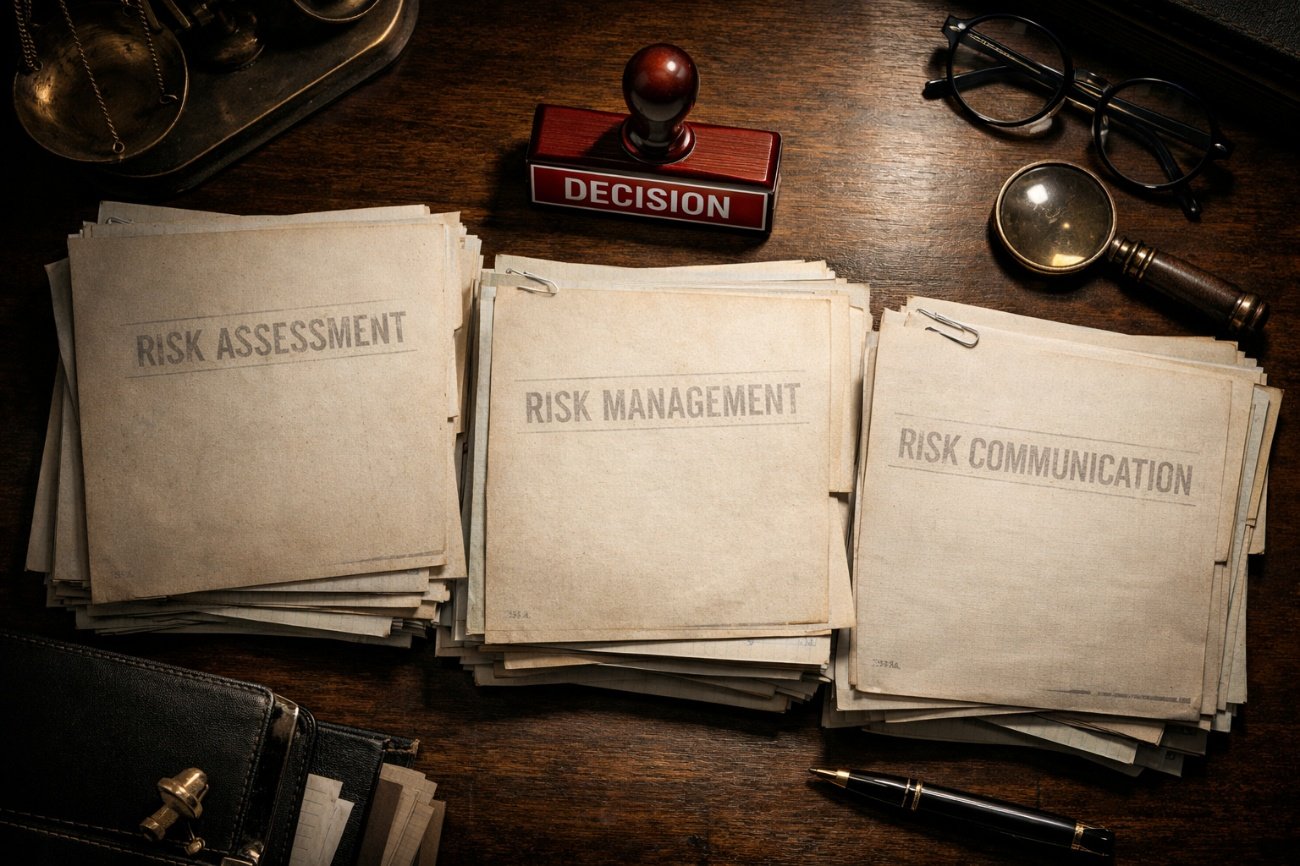
- Risk analysis = risk assessment + risk management + risk communication.
- Risk assessment has four steps: hazard identification → hazard characterization → exposure assessment → risk characterization.
- Risk matrices help prioritize—but qualitative labels (“high/medium/low”) fail without defined criteria.
- Semi-quantitative tools often outperform simple matrices for ranking many hazards.
- Regulators use risk-based inspection prioritization matrices to allocate limited resources.
Definitions First (So the Rest Stays Accurate)
Hazard vs Risk
A hazard is an agent with the potential to cause harm:
- Biological (e.g., pathogens)
- Chemical (e.g., contaminants like PFAS)
- Physical (e.g., metal fragments)
- Allergenic
A risk reflects:
Probability (likelihood) × consequence (severity) in a real scenario.
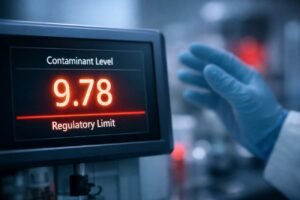
Common failure mode: treating “detected” as “danger.”
Detection alone does not equal meaningful risk without exposure and severity context.
Risk Analysis: The Umbrella Framework
Internationally, risk analysis includes three components, formalized by the Food and Agriculture Organization and World Health Organization:
- Risk assessment (scientific evaluation)
- Risk management (policy and operational decisions)
- Risk communication (two-way stakeholder dialogue)
Governance best practice:
Maintain functional separation so scientific evaluation remains objective and trade-offs are transparent.
Risk Assessment: The Scientific Core
The widely accepted 4-step model (described in WHO/FAO guidance such as EHC 240) includes:
1️⃣ Hazard Identification
What agent can cause harm?
2️⃣ Hazard Characterization
What is the nature and severity of adverse effects?
(For chemicals, this includes dose–response.)
3️⃣ Exposure Assessment
How much of the hazard reaches consumers?
At what frequency?
4️⃣ Risk Characterization
Integrate severity + exposure to estimate risk.
This structure applies to chemical, microbiological, and many other food safety risks.
Qualitative vs Quantitative vs Semi-Quantitative
- Qualitative: Uses defined descriptive categories (low/medium/high).
- Semi-quantitative: Assigns numeric scores to defined criteria.
- Quantitative: Uses mathematical modeling and numerical exposure data.
Full quantitative risk assessment is data-intensive and expensive.
Screening tools help determine where deeper analysis is justified.
Peer-reviewed tools like those described by Ross & Sumner emphasize structured, spreadsheet-based models for practical use.
Risk Matrix: What It Is (and When It Fails)
A risk matrix combines:
- Likelihood (probability)
- Severity (consequence)
to produce priority categories.
Often structured as:
4×4 or 5×5 grids
Severity (rows) × Probability (columns)
Overall risk can be expressed as:
- Matrix color category
- Numeric product (severity × probability)
Why Risk Matrices Are Useful
They:
- Force explicit discussion of exposure drivers
- Support consistent testing frequency decisions
- Help allocate inspection resources
For example, the Food and Agriculture Organization Risk-Based Food Inspection Manual demonstrates prioritization using:
- Establishment compliance profile
- Product risk profile
to assign inspection priority.
The Biggest Risk-Matrix Mistakes
1️⃣ Undefined Categories
“High likelihood” means what, exactly?
Without objective definitions, repeatability suffers.
Fix:
Define measurable criteria:
- Historical contamination rate
- Geographic origin risk
- Process removal steps
- Time windows
- Vulnerable populations
2️⃣ HM vs MH Ambiguity
High likelihood / medium consequence
vs
Medium likelihood / high consequence
These can collapse into similar rankings, reducing discrimination.
Fix:
Use semi-quantitative scoring:
- Separate likelihood drivers
- Separate severity drivers
- Document weighting
3️⃣ Treating Output as “Truth”
A risk matrix is a decision aid—not a substitute for full exposure assessment.
Ross & Sumner emphasize that screening tools must escalate high-ranked items to deeper analysis.
Fix:
Explicitly label your matrix as:
- Screening tool
- Prioritization tool
- Communication tool
Match rigor to purpose.
Building a Risk Matrix That Holds Up in Audit
Step 1: Define the Scenario (Not Just the Hazard)
Wrong: “Listeria”
Correct:
“Post-lethality contamination of ready-to-eat product during slicing and packaging, followed by refrigerated shelf life.”
Scenarios drive exposure logic.
Step 2: Define Severity Using Outcome Logic
Severity may consider:
- Hospitalization or death potential
- Chronic health effects
- Vulnerable populations
Ross & Sumner explicitly include population susceptibility in severity modeling.
Step 3: Define Likelihood Using Exposure Drivers
Exposure depends on:
- Contamination probability
- Initial contamination level
- Growth/inactivation during processing
- Cross-contamination potential
- Supply chain factors
Step 4: Choose the Right Level of Rigor
- Qualitative → rapid triage
- Semi-quantitative → ranking many hazards
- Quantitative → high-stakes regulatory decisions
Table: Risk Tools and When to Use Them
| Tool | Best For | Common Failure | Better Practice |
| Simple risk matrix | Quick prioritization | Vague labels | Define criteria clearly |
| Semi-quant scoring | Ranking many hazards | Hidden weighting bias | Publish scoring rules |
| Quantitative RA | Regulatory decisions | False precision | Document uncertainty |
| Inspection priority matrix | Allocating inspections | Ignoring compliance history | Combine compliance + product risk |
Risk-Based Inspection & Prioritization
Regulators apply risk-based inspection models to allocate limited resources.
Factors often include:
- Product type risk
- Compliance history
- Vulnerable population exposure
- Production volume
This aligns inspection frequency with risk—not equal treatment across facilities.
When One Matrix Isn’t Enough (Chemical Hazard Prioritization & MCDA)
For chemical hazard prioritization (e.g., PFAS ranking), multi-criteria decision analysis (MCDA) approaches can:
- Incorporate toxicity
- Persistence
- Bioaccumulation
- Exposure potential
- Regulatory status
This avoids oversimplifying complex chemical risk profiles into a single crude score.
Practical Checklist
Build
☐ Define hazard + scenario + population
☐ Select method (qualitative / semi-quant / quantitative)
☐ Define severity with objective criteria
☐ Define likelihood using contamination + exposure drivers
Use
☐ Apply consistently across products
☐ Use results to prioritize controls and verification
☐ Escalate high-ranked items for deeper analysis
Governance
☐ Separate scientific logic from trade-off decisions
☐ Document assumptions and uncertainty
FAQ
What is the difference between risk analysis and risk assessment?
Risk analysis includes assessment, management, and communication. Risk assessment is the scientific evaluation component.
What are the steps of risk assessment?
Hazard identification → hazard characterization → exposure assessment → risk characterization.
What is a risk matrix?
A tool combining likelihood and severity to assign priority categories.
Why do risk matrices fail?
Because qualitative labels are subjective unless criteria are explicitly defined.
Final Takeaway
Risk assessment is about structured thinking—not color-coded boxes.
- Define the scenario.
- Define severity objectively.
- Define likelihood based on exposure drivers.
- Use matrices as decision aids—not as substitutes for science.
When built properly, risk matrices improve prioritization.
When built poorly, they create false confidence.
Video Companion
For training and internal alignment—especially on HM vs MH ambiguity, semi-quant scoring, and inspection prioritization models—see:
https://www.youtube.com/@Foodnotfooled-2u