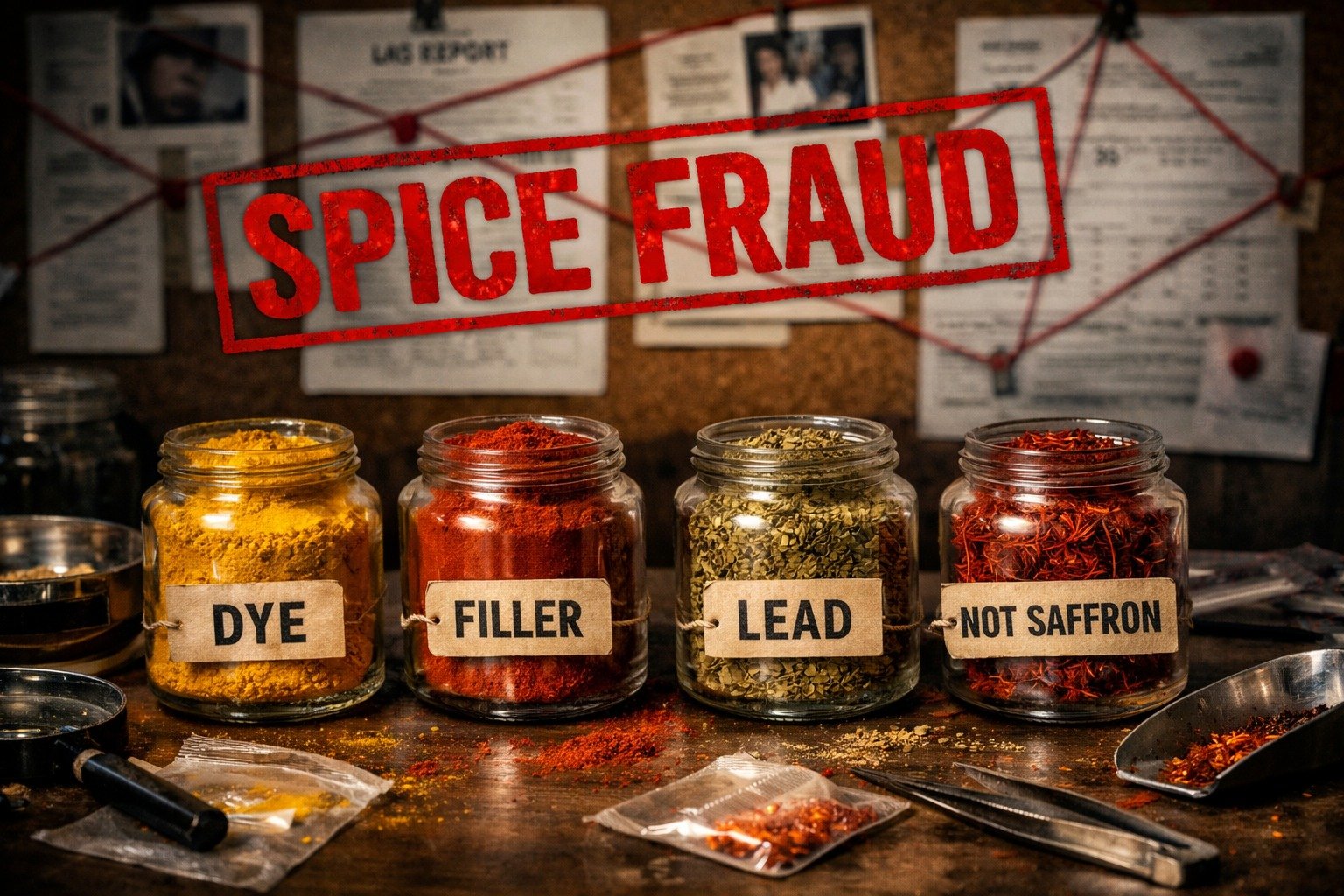
What Is Spice Fraud?
Spice fraud is the intentional adulteration or misrepresentation of spices and herbs for economic gain—commonly through illegal dyes, heavy-metal pigments, bulking fillers, or substitution with cheaper plant material.
Unlike many food frauds, spice adulteration can directly become a public-health crisis because many adulterants are toxic even at low, repeated exposures.
Key Takeaways
- Common adulterants include lead compounds, illegal industrial dyes, fillers (starch, chalk), and substitute plant matter.
- One contaminated spice lot can cascade into hundreds of downstream products, triggering large recalls.
- Chronic toxins such as lead can accumulate over time, especially affecting children.
- Herb substitution is widespread because visual detection is difficult.
- Effective mitigation requires supplier governance, traceability, and risk-based testing.
Scope
This article covers fraud in ground and whole spices, dried herbs, and spice blends, focusing on integrity risks that may become safety hazards.
Audience: Food safety/QA professionals, procurement teams, auditors, laboratories, regulators
Disclaimer: Informational only; not legal advice
Definitions and Framing
What Is Spice Fraud?
Spice fraud involves intentional deception about identity, purity, quality, or origin for profit. Because spices are often powdered and visually persuasive, color and weight manipulation are common tactics.
Hazard vs. Risk — The “Small Dose” Trap
Spices are used in small quantities, but repeated exposure to toxic adulterants can produce significant cumulative health effects.
For example, lead has no safe exposure threshold for children, and chronic intake can result in neurological damage.
What Spice Fraud Looks Like (Main Tactics)
1) Toxic Color Adulteration
Industrial pigments are added to enhance color and perceived quality.
Common examples:
- Lead chromate or lead oxide in turmeric or chili
- Illegal dyes used to intensify reds and yellows
Risks: Neurotoxicity, carcinogenic potential, regulatory violations
2) Bulking with Cheap Fillers
Adding inexpensive materials to increase weight.
Examples include:
- Starch or flour
- Chalk or talc
- Ground seeds or husks
- Sawdust or plant waste
Fillers may introduce additional hazards such as allergens or contaminants.
3) Plant Substitution (Fake Herbs and Fake Saffron)
Replacing authentic plant material with cheaper substitutes.
Examples:
- Olive or myrtle leaves sold as oregano
- Dyed corn silk or safflower sold as saffron
This can be purely economic fraud or introduce pesticide and safety risks if non-food-grade material is used.
Iconic Cases (Lessons for Professionals)
Hungary’s Paprika Poisoning, 1994
Paprika was adulterated with lead-based pigment to intensify color, leading to dozens of hospitalizations and criminal prosecutions.
Lesson: Color fraud can rapidly escalate into poisoning when toxic industrial materials are used.
Sudan Dye Recall in the UK, 2005
Illegal dye contamination in chili powder triggered one of the largest food recalls in UK history, affecting hundreds of products across categories.
Lesson: Spice adulteration acts as a multiplier risk across complex food supply chains.
Turmeric and Lead Contamination (2010s)
Investigations linked lead-adulterated turmeric to widespread exposure, including cases of childhood lead poisoning in diaspora communities.
Lesson: Everyday spices contaminated with chronic toxins create stealth exposure over time.
Fake Oregano Investigation (UK/Ireland, 2015)
Testing revealed that many retail oregano samples contained significant amounts of foreign leaves, often undetectable by consumers.
Lesson: Leafy herbs are highly vulnerable to substitution fraud.
Counterfeit Saffron Ring (Spain, 2021)
Authorities uncovered an organized network selling adulterated saffron mixed with low-grade or fake material, highlighting the criminal dimension of high-value spice fraud.
Lesson: For premium spices, authenticity is a governance and intelligence issue, not just a laboratory problem.
Why Spices Are Easy to Fake (Supply Chain Vulnerabilities)
Spices are particularly susceptible due to:
- Long, multi-layered supply chains
- Aggregation from multiple farms or traders
- Powdered form removing visual identifiers
- Limited routine testing
- High value-to-weight ratio
Risk Multipliers
- Powdered products
- Premium or origin-specific claims
- Supply shortages or price spikes
- Weak traceability
- Multiple intermediaries
Detection Methods: The Practical Toolbox
Effective detection relies on layered testing strategies.
Microscopy
Identifies foreign plant matter and structural differences.
DNA Testing (PCR / Barcoding)
Confirms species identity in herbs and spices.
Spectroscopy
Rapid screening for anomalies; useful for detecting certain pigments or contaminants.
Chromatography with Mass Spectrometry
Confirms illegal dyes and chemical adulterants at low concentrations.
Heavy Metal Analysis
Techniques such as ICP-MS or XRF detect lead and other toxic metals.
Operational workflow:
Screen → Hold → Confirm → Disposition → Corrective action
Where HACCP Ends — and VACCP Begins
HACCP focuses on unintentional hazards. Spice fraud involves deliberate manipulation designed to evade routine controls.
VACCP addresses vulnerabilities by asking:
- Where is fraud profitable?
- Where is detection weak?
- How can opportunities be reduced?
Integrating VACCP with procurement, specifications, testing, and traceability is essential for spice programs.
Spice Fraud Tactic → Hazard Concern → Best Controls
| Fraud Tactic | Primary Concern | Best Controls |
| Lead pigments | Toxic exposure | Supplier governance + heavy-metal testing |
| Illegal dyes | Carcinogenic risk | Dye-specific analytical methods |
| Herb substitution | Integrity + unknown risks | Microscopy + DNA testing |
| Saffron counterfeiting | Economic crime | Chain-of-custody + authenticity testing |
| Allergenic fillers | Acute reactions | Allergen testing + supplier controls |
Audit-Ready Prevention Checklist
- Define scope (products, claims, origins)
- Rank vulnerabilities by product type and history
- Strengthen supplier approval and transparency
- Establish authenticity specifications
- Implement risk-based testing programs
- Conduct traceability stress tests
- Train receiving staff to spot red flags
- Maintain escalation and recall procedures
- Reassess risks after market disruptions
Myth-Busting
Myth: Spices are used in tiny amounts, so contamination is insignificant.
Reality: Chronic toxins accumulate over time and can cause serious harm.
Myth: Bright color indicates high quality.
Reality: Color can be artificially engineered using illegal pigments.
Myth: Spice fraud only occurs in developing countries.
Reality: Global supply chains mean adulterated ingredients can affect products worldwide.
FAQ
What is spice fraud?
Intentional adulteration or mislabeling of spices or herbs for economic gain, often involving toxic additives or substitution.
Why is turmeric linked to lead poisoning?
Some turmeric has been adulterated with lead compounds to enhance color, leading to elevated lead exposure in consumers.
What triggered the large UK spice recall?
Illegal dye contamination in chili powder spread through ingredient supply chains into many finished products.
How common is fake oregano?
Investigations have found substantial substitution rates in retail samples, sometimes comprising large portions of foreign leaves.
What tests detect spice adulteration?
Microscopy and DNA identify plant substitution, chromatography confirms chemical adulterants, and metal analysis detects toxic elements.
Video Companion
Video companion:
For a documentary overview of paprika poisoning, dye recalls, turmeric contamination, fake oregano, and counterfeit saffron, watch:
https://www.youtube.com/watch?v=xESJDbXopQg&t=1s
This video presents the narrative context, while this article translates those events into prevention controls, testing strategies, and audit-ready actions.